Every pressing, boxset and reissue, tracked and sorted.
Not a marketplace. A private account of what is actually in the crates — catalogue numbers, pressings, grades, what you paid, and which shelf it went back on.
Tracklist
Everything the app does, in the order you'd use itLog a copy, not a title
Label, title, format and catalogue number, so the 1957 press and the 2014 reissue are two rows rather than one.
Look it up, don't type it
Scan or type the barcode, or search by catalogue number or by artist and title. The pressing's labels, year, country and format fill in from Discogs, and you edit anything before saving.
Bring your Discogs collection
Upload the collection export from Discogs. Each release comes in fully looked up, with your grades and notes from Discogs on it. A collection goes back out the same way, as a file Discogs imports. Any other spreadsheet comes in as a CSV, its columns matched to the fields.
Shoot the sleeve and the label
Up to five photographs a record: front, back, label, runout. What you own, and the state it was in.
Grade it the same way twice
The Goldmine ladder further down, for the record and the sleeve separately, so January's VG+ still means VG+ in November.
A collection per crate
The jazz shelf, the singles box, the ones still in the hallway. Each collection counts its own records and adds up what they cost.
What you paid, and when
Price and date per copy, in your currency. The receipt goes on the record with the photographs.
Table, cards or crate
View a collection as a table to sort and search, or as cards with the covers. Its LPs also stand in crates, one per genre, filed behind dividers: lift one out to see its grades, and turn it over. A share link opens all three.
The insurance document
Every record in a collection, with its catalogue number, price paid and a photo, as one PDF: for an insurer, or for a police report.
Condition evidence
Dated sleeve and label photographs, graded before the loss rather than remembered after it.
The duplicate check
Search your own crates from a phone, in a shop, before you buy the same pressing twice.
Your data, out
A CSV of every field per collection, a Discogs collection file to take a crate back to Discogs, or a zip of the whole account with the original photographs and documents. On every plan, whenever you ask for it.
A link, not a profile
Show a crate to a friend with a read-only link to one collection, every record you own or the whole account. What you paid stays off it. No feed, no followers, no leaderboard, and nothing is sold on.
Start a collection
Free, unlimited records. Two minutes for the first one, less for the rest.
Liner notes
Why we built itThe first duplicate is funny. You find a clean Japanese pressing in a shop in a city you don't live in, you buy it, you get home, and it is already on the shelf — bought eighteen months earlier, in a different city, in exactly the same mood. The second duplicate is less funny. By the fourth you have stopped telling people.
Spreadsheets fail here for a specific reason: a record is not a title, it is a copy. A 1957 Lexington Avenue Blue Train and a 2014 reissue share a name and nothing else — not the runout etchings, not the label, not the value, not the reason you wanted it. A row that says Coltrane — Blue Train tells you nothing on the day it matters.
So stashu records copies. Label, title, format and catalogue number, the pressing and the grade, photographs of the sleeve and the label, what you paid and when, and the crate it lives in. One row a copy, and a search that finds it from a shop doorway.
Then, on the day a pipe bursts or a window goes in, it prints the whole thing as a document an adjuster can work from. That is the entire ambition. No feed, no followers, no public profile — just an accurate, private, slightly obsessive account of the crates.
Flip the crate
Pick a sleeve — see the record behind itBlue Train
John ColtraneThe copy that made you start counting. Lexington Avenue address, ear stamp, and a sleeve that has been out of its jacket too many times.
- Label
- Blue Note
- Format
- LP
- Pressing
- 1957 · NY 47 W 63rd
- Matrix
- RVG · ear stamp
- Media / sleeve
- VG+ / VG
- Paid
- £380 · Jun 2018
Table, cards or crate
Three ways to look at one collectionA collection opens as a table, a row a record, to sort by any column and to search. The cards put the covers first, with the grade, year and price under each. A collection with LPs in it opens as a crate as well, one per genre, its records filed behind dividers to flip through and lift out one at a time.
The crate holds LPs only for now. Singles and CDs stay in the table and the cards.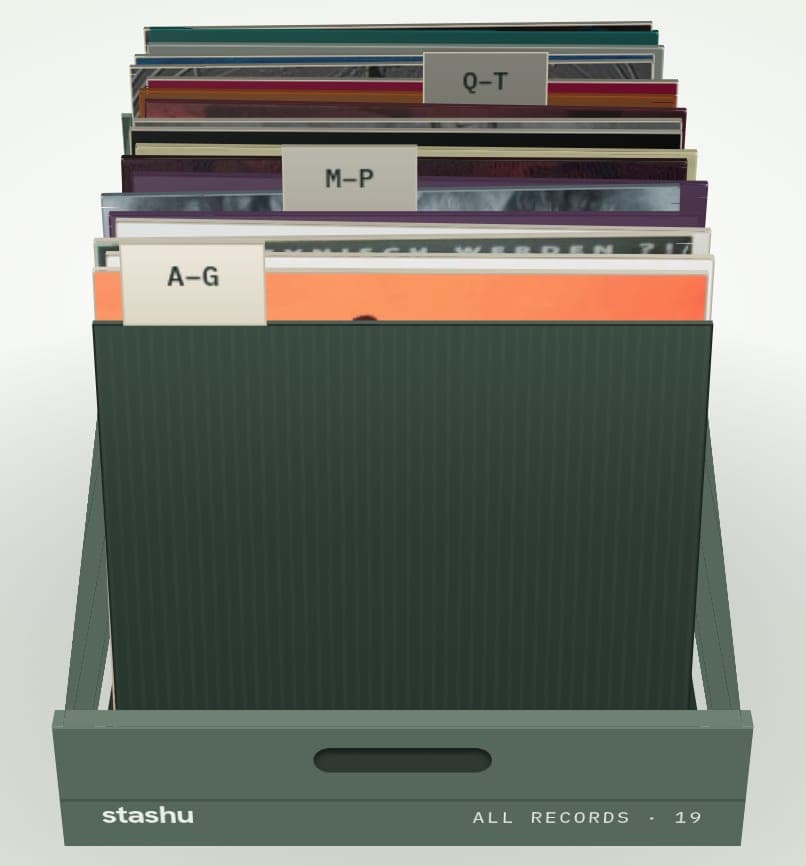
Condition ladder
Goldmine, in plain wordsVery Good Plus
Played but cared for. Faint marks that do not affect play, light wear at the corners or seams.
Start with the shelf you'd replace first
Free, unlimited records. Upload your Discogs collection and it comes in looked up, or log the first one by its barcode.